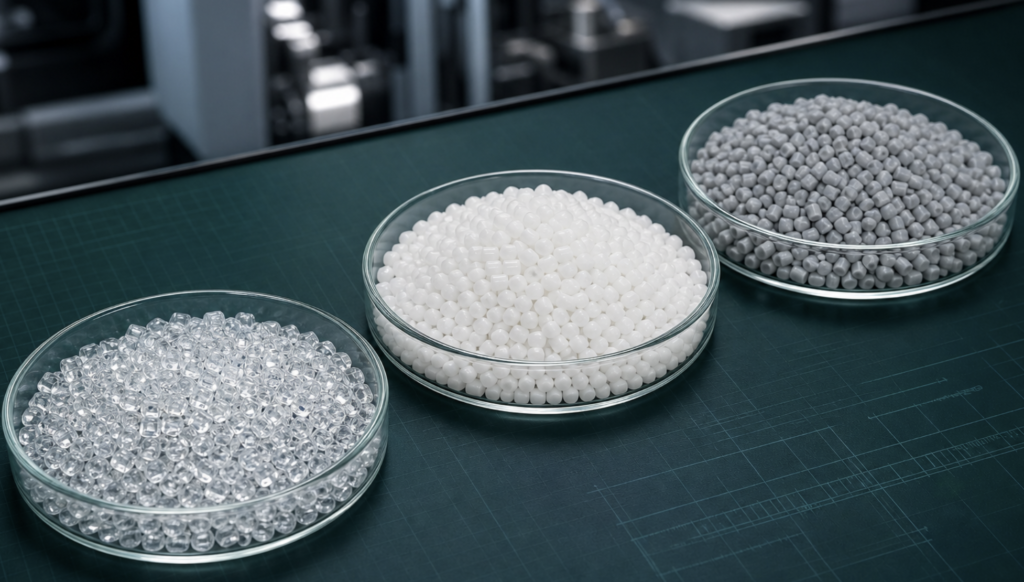
The Ultimate Guide to PC vs. ABS vs. PC-ABS: Selecting the Right Resin for High-Precision Enclosures
Selecting the ideal thermoplastic resin is the foundational step in any successful injection molding project. For electronic enclosures, the decision often narrows down to three primary candidates: ABS, Polycarbonate (PC), and the PC-ABS blend. At Kysen Mold, we combine material science with decades of manufacturing expertise to help you navigate this choice based on performance, cost, and manufacturability.
Technical Property Comparison
| Property | ABS (General Grade) | Polycarbonate (PC) | PC-ABS Blend |
|---|---|---|---|
| Tensile Strength | 40 – 50 MPa | 60 – 70 MPa | 50 – 60 MPa |
| Heat Deflection (0.45 MPa) | ~90°C | ~140°C | ~110°C – 125°C |
| Shrinkage Rate | 0.4% – 0.7% | 0.5% – 0.8% | 0.4% – 0.6% (Most Stable) |
| Impact Resistance | Moderate | Extremely High | High |
1. ABS: The Versatile Choice for Consumer Electronics
ABS (Acrylonitrile Butadiene Styrene) is favored for its excellent flow characteristics and superior surface finish. It is often the primary choice for household appliances and handheld devices where budget constraints are tight. During our DFM analysis phase, we often recommend ABS for parts requiring secondary operations like painting or vacuum plating, as it bonds exceptionally well with coatings.
- Advantages: Economical, low shrinkage, high flow rate, easy to process.
- Typical Applications: Remote controls, computer peripherals, and toys.
2. Polycarbonate (PC): The Engineering Armor
If your device must survive high-impact drops or operate in extreme temperatures, pure Polycarbonate is the answer. It is virtually unbreakable and can be formulated for high transparency (medical-grade). However, PC is more challenging to mold due to its high viscosity and tendency for internal stress. At Kysen Mold, we utilize advanced precision molding techniques to mitigate common PC defects like stress cracking and knit lines.
- Advantages: Optical clarity, exceptional toughness, superior heat resistance.
- Typical Applications: Medical device housings, automotive lighting, and industrial ruggedized tablets.
3. PC-ABS: The High-Performance Hybrid
PC-ABS is widely considered the “Gold Standard” for professional electronic enclosures. It bridges the gap by offering the toughness of PC and the processability of ABS. In our latest medical enclosure case study, the use of PC-ABS was instrumental in achieving a ±0.015mm tolerance while maintaining a flawless “A-class” surface finish.
Design Considerations for Material Success
To maximize the benefits of these materials, your CAD design must align with their physical properties. Here are three critical tips from our engineering team:
- Draft Angles: PC requires slightly larger draft angles (1.5° to 2°) compared to ABS (1°) to ensure easy ejection without scuffing.
- Wall Thickness: Avoid thickness transitions greater than 25% to prevent sink marks, especially in high-gloss PC-ABS parts.
- Gate Location: PC-ABS blends are sensitive to shear heat; gate placement is critical to avoid “silver streaks.” Learn more in our DFM design guide.
Summary Recommendation:
Choose ABS for cost-sensitive consumer projects. Choose PC for extreme ruggedness or transparency. For the vast majority of high-precision electronic enclosures, PC-ABS offers the best balance of mechanical strength and dimensional stability.
Ready to optimize your next project?
Our engineers provide a free DFM review and material consultation for every inquiry.
Get a Free DFM Review & CONTACT Now