Most of the money in a China mold project is spent before the deposit is paid. Not on the tool itself — on the decisions made while the part is still a drawing: which steel, which cavity count, which gate position, which supplier, which payment structure. Get those right and the project runs quietly. Get them wrong and you pay twice, in the mold and in the schedule.
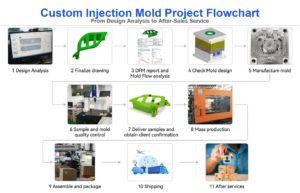
This guide follows the order a buyer actually decides things. Ten steps, from the moment you know you need tooling to the moment you sign off on the first acceptable parts — plus four sections on the details that decide cost: DFM, steel, payment, and defects.
It is not a sales page. Each section tells you what to check, what a good answer looks like, and where to go deeper if that step is the one you are stuck on.
Why buyers source injection molds from China — and when it is the wrong decision
The headline reason is usually stated wrong. Buyers say “cheaper labor,” but labor is a shrinking share of what a mold costs. The real advantages are structural: a dense machining cluster puts mold bases, standard components, electrodes and steel within a short drive, and steel purchasing sits close to the mills, which matters because steel is one of the largest line items in a tool.
That advantage is real for the right project. If your part will run in repeat production and the tolerance windows sit inside what the process can hold, China is usually the rational choice: the tool cost per part amortizes, and the shop has done your kind of part before.
It is the wrong decision in three situations. When annual volume is so low the tool never amortizes, because you are exporting cash flow today for savings that arrive over years. When the tolerances are tighter than the process can hold, because no supplier geography fixes that. And when the part is expected to change frequently in the first year, because co-location and same-day iteration are worth more than tooling savings.
Decide this first. Everything below assumes you have, and it changes what you should look for in a supplier. The relevant capability set is described under custom injection mold manufacturing.
What you are actually buying: the anatomy of a mold
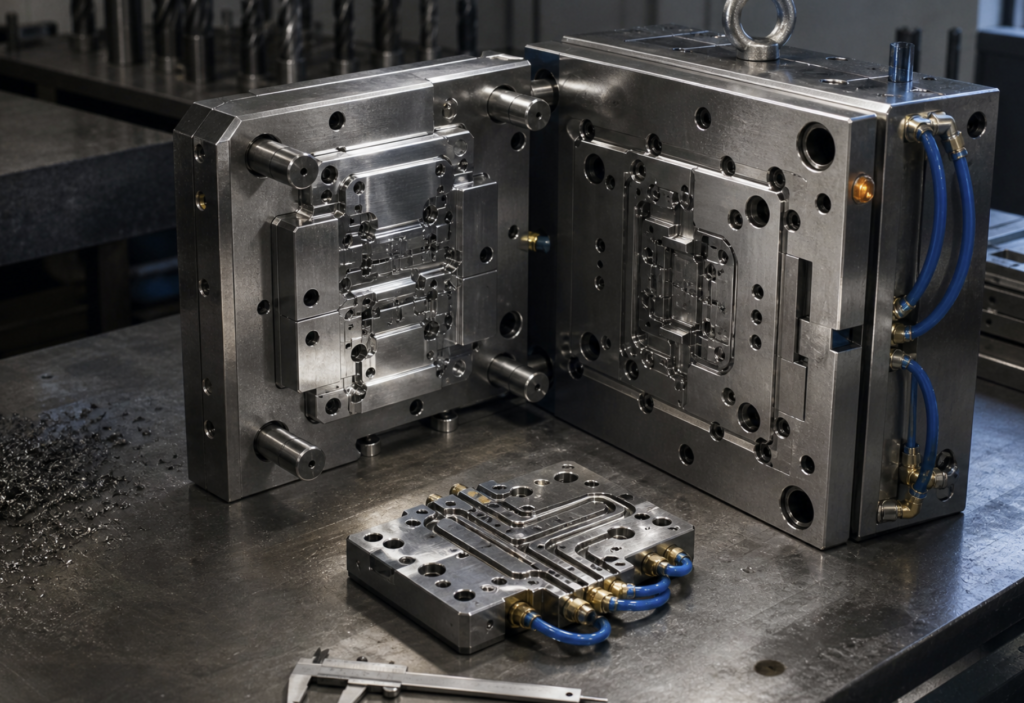
Once you accept that you are buying a tool, break the word down into five things you can inspect. A mold base, which sets the standard, the plate thickness and how everything else is mounted. A cavity and core, the two halves that form your geometry — the part that most quotes are actually about. A feed system, whether a simple runner and gate or a hot runner manifold. A cooling circuit, which decides cycle time more than any press setting. And an ejection system, which decides whether the part leaves the tool intact.
Every one of those is a place where two quotes can hide two different objects behind the same price. A mold base from a catalog standard and a mold base cut to whatever was on the shelf are both “a mold base.” A single cavity and an eight-cavity tool are both “a mold.” A pre-hardened cavity and an H13 cavity with a nitride treatment are both “steel.” This is why comparing mold prices without comparing specifications is not a comparison at all.
Learn this vocabulary before you talk to suppliers. It is the difference between negotiating and guessing. You can see how these five systems come together — and where a shop proves it can hold a specification — on our production capabilities page, and the sequence from drawing to certified tool is laid out in our mold making workflow.
Step 1 — Freeze the part design before you contact any supplier
There is a specific failure pattern behind most disputed mold changes: the buyer sends a drawing that is still moving, the supplier quotes the version they received, and three weeks later the part changes. Now the question is who pays for the revision. The answer costs far more time than the revision itself.
Four things need to be fixed before you send an RFQ.
Wall thickness, because it sets filling pressure, cooling time and shrink. Variations turn into sink and warpage, and no tooling decision can compensate for a wall that changes size without transition. Draft angles, because a vertical wall will drag and scratch no matter how the tool is polished. Gate location, because the gate decides flow direction, weld line position and where the cosmetic blemish sits — and it is the buyer’s decision, not the mold maker’s guess. And the material family, because shrink rate, moisture sensitivity and filled-versus-unfilled all feed directly into the tool design.
If you have not locked these, the RFQ you receive is a quote for a guess. The rules that govern wall thickness and transitions are collected in our wall thickness guidelines for injection molding, and the trade-offs between families — including why an “equivalent” grade often is not — are covered in how to select the plastic material.
Step 2 — Prepare a CAD file that can be quoted in 24 hours
The single fastest lever on your own schedule is your CAD file. A clean file can be quoted and reviewed in a day. A messy one produces clarifying emails that each cost a day.
Send STEP. It carries the geometry both sides actually need. STL gives a tessellated surface with no clean faces or edges, which makes DFM analysis unreliable, and native CAD files from your own system force the supplier to translate — with no guarantee that the translation is faithful to what you designed. Include a coordinate system with the part sitting in its intended molding orientation and units stated explicitly. Do not include hidden solids, reference geometry from other parts, or the packaging model that shares the same assembly. And send one part per file unless the parts are genuinely molded together.
Then hold yourself to the five-minute check before export: units, orientation, draft present on every vertical wall, no zero-thickness or overlapping faces, and a single closed solid. Buyers who do this consistently get their quotes earlier and their DFM feedback with fewer questions attached. The full pre-export checklist is in how to prepare a CAD file for quoting. If you want the file reviewed rather than just priced, request a quote and DFM check together.

Step 3 — Shortlist manufacturers: 7 questions to ask before you send an RFQ
You are not trying to find the cheapest quote. You are trying to find out what kind of organization you are talking to, because that determines whether the tool you approve is the tool you receive.
Three questions do most of the work. Are you a factory or a trading company? Ask for the plant address, then ask to see the machines and the current jobs on them. A trading company is not automatically disqualified — some add real project management — but the answer changes who is accountable for quality and who holds your tool. Can I specify the steel grade and the brand? A supplier that stocks a range and can show purchase documentation expects to be checked. And where is mold ownership written in the contract? If the answer is vague, the tool is not really yours.
The other four are about process discipline: who performs DFM and signs it, the trial-shot and revision policy, what documentation ships with the tool, and what happens when a dimensional report fails. How a supplier reacts to being asked is more informative than the answer itself. Suppliers with nothing to hide answer quickly and offer evidence.
The complete question set — and what a weak answer to each sounds like — is in the 7 questions to ask a China mold manufacturer. A concrete measure of what a shop has already built is a useful cross-check; projects we have delivered shows the part families and tool sizes that are routine for us.
Step 4 — The DFM review: what gets caught before steel is cut
DFM is where sourcing money is saved, because it is the last moment when a change costs drawings instead of steel.
A competent DFM report answers four questions. Will the part fill from the proposed gate without short shots or excessive pressure — and if not, where does the gate move? Will it cool evenly enough that the part comes out straight, or does the cooling circuit need re-routing? Where will the material shrink into sink marks or pull into warpage? And can the part actually eject, given the draft and undercuts you have designed?
Speed is a benefit, not the objective. A review that returns in a day is useful only if it returns with findings. The reason a short turnaround matters commercially is that it compresses the loop between “we sent the file” and “we know what has to change” — which is usually the real critical path in a cross-border project, where every question round costs a working day of time-zone lag. What a proper cycle contains, gate by gate, is described in what a 24-hour DFM turnaround includes; the underlying design rules and the corrections they drive are documented in DFM analysis and engineering support.
Before you approve a DFM report, check that it names specific geometry, not general advice. “Consider adding draft” is not a finding. “Add 1.5° draft to the four ribs on the long side or they will scuff on ejection” is.
Step 5 — Reading a mold quote: the lines that decide the real price
A mold quote is only comparable line by line. Seven lines carry most of the difference in price and all of the difference in risk.
The steel grade and hardness for cavity and core, specified separately. The mold base standard and plate thickness, which decide rigidity and lifespan. The cavity count, which multiplies tooling scope and divides cycle cost. The runner system — hot or cold, and if hot, which manifold brand. The surface finish or texture, and who applies it. The number of trial shots included. And the warranty, in months and in cycles.
Now the pattern: when one quote is materially below the others, the difference sits in one of those seven lines — a softer steel, a lighter base, one fewer cavity than you assumed, a cold runner where you expected hot, texture quoted separately. The cheapest quote is rarely the cheapest mold; it is the quote with the most items moved outside its own scope. The full method is in how to compare injection mold quotes line by line. If a line is ambiguous, get the supplier to confirm it in writing — talk to our engineering team if you want a second read on a quote you already have.
Total cost of ownership: why the mold price is the smallest number
Buyers focus on the tool price because it is the number on the page. Over the life of the project it is usually the smallest of three costs: the mold price, paid once; the part price, paid on every shipment; and the cost that appears in neither quote.
A tool that runs a longer cycle or needs more manual handling costs more per part forever — a few seconds of cycle time compounds across a production run in a way that a few hundred dollars of tool price never does. The third cost is the rework, the air-freighted samples, the production window you missed because the tool needed a second correction, and it is usually where the largest single loss sits.
The implication is that a modestly higher tool price which buys better steel, a better cooling layout or a properly validated first trial is normally the cheaper decision. Price the tool against the life of the part, not against the other quotes.
Step 6 — Steel grade and heat treatment: why “P20” is not a specification
“P20” on a quote tells you almost nothing. It is a family name, not a grade commitment, and it is quoted for tools from a few thousand shots to several hundred thousand. Two suppliers can both write “P20” and deliver cavity blocks that behave differently under the same resin.
A steel specification has three parts: the grade, the hardness, and whether it is pre-hardened or supplied for later heat treatment. P20 is typically pre-hardened in the low thirties on the Rockwell C scale; 718H sits in a similar band with better homogeneity; NAK80 is pre-hardened in the high thirties where polishability matters; S136 and comparable stainless grades suit corrosive resins and are commonly hardened after rough machining; H13 is the hot-work answer when abrasive fillers are involved. Force the decision to be explicit on all three parts, cavity and core stated separately.
What drives the choice is shot count and resin. A prototype tool and a tool expected to run for years do not justify the same steel, and paying for H13 on a short-run project is waste. Going the other way — a soft P20 tool for a glass-filled part expected to run long — ends in a polished-out cavity, worn gates and a second tool. Filled and reinforced grades are abrasive; PVC, POM and some flame-retardant systems are corrosive, and both change the steel decision more than the price does.
The grade-versus-shot-count logic, plus the three questions to ask before approving a steel spec, is set out in choosing the right mold steel grade. And because the steel on the quote and the steel in the block are two different things until someone checks, our practice is to document incoming material — see how we verify incoming steel and mold quality.
Step 7 — Payment terms, deposits and what actually protects the buyer
Payment structure is risk allocation, and it is the one term that protects you when something goes wrong.
The common structure is a deposit against order with the balance against pre-shipment inspection or before shipment, settled by telegraphic transfer. A letter of credit makes sense when the order value is large or your own finance function requires a documentary layer — but it costs money and adds administration, so it is not automatically the “safer” option on a modest tool.
The structural point matters more than the instrument: tie each payment to a deliverable you can verify, not to a date. Documented steel arrival is a milestone. A completed DFM report is a milestone. T1 samples with a dimensional report are a milestone. The expiry of a calendar month is not. When payments are calendar-bound your only remaining lever is a dispute; when they are deliverable-bound your lever is the next payment.
Two clauses deserve explicit language. Mold ownership, stating that the tool and its design data become your property on payment, with the right to take possession. And a revision scope saying what happens, and at whose cost, when the first trial reveals a design change rather than a tool fault. Where a supplier resists writing either clause down, treat that as data.
If you want terms discussed against a specific project, discuss payment terms with our team. Quotes are issued with the assumption set written out, so you can see what is included before the terms conversation starts — get a quote with DFM feedback.
Step 8 — The 8 weeks after the deposit: what happens and what you should check
Once the deposit clears, the project moves into a mostly predictable sequence: steel ordered and DFM locked; rough machining and the big material removal; semi-finishing and any heat treatment; EDM and final machining to bring cavity and core to dimension; fitting, polishing and assembly into a working tool; the first trial; corrections and optimisation; then inspection, texture if specified, and packing.
The rhythm is not the problem. The problem is that buyers go quiet in the middle of it and re-engage only at trial, when the tool is already cut and every change is expensive.
Four things are worth doing during those weeks. Confirm the DFM findings were actually implemented, not just reported. Ask to see the steel purchase documentation when it arrives. Follow the machining progress, particularly a schedule slipping early rather than late — a slip in week two is recoverable, a slip in week seven is not. And prepare your own inputs early: the material for the trial, your inspection criteria, and the person who will measure the first samples.
A weekly report is useful only if it contains three things: which operations were completed, what is planned next, and anything currently at risk with a proposed response. “Progressing well” tells you nothing you can act on.
The week-by-week sequence, including what the buyer should be checking in parallel at each stage, is laid out in week-by-week: deposit to first shot.
Step 9 — T1 samples, first article inspection and sign-off
The first trial is the moment the project becomes verifiable, and what you do with the samples decides whether the second trial is a formality or another cycle.
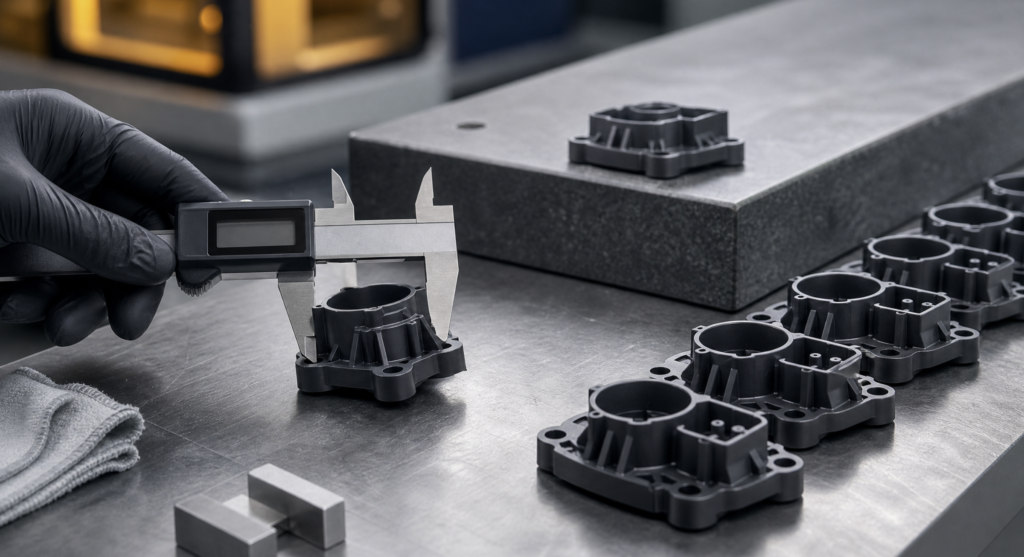
Five data points belong in a T1 report. Dimensional results against the drawing, not just “within tolerance” — actual measured values, with the method and datum scheme stated. Appearance, against the agreed cosmetic standard and under agreed lighting. Cycle time, because it decides your part price for the life of the tool. Part weight, the fastest indicator of whether the cavity is filling as designed. And shrink behaviour — whether dimensions are consistently offset or scattered.
For sample quantity, AQL sampling to ISO 2859-1 is the standard approach: it gives a sample size and an accept/reject number from lot size and inspection level, instead of an arbitrary “we will check some parts.” Decide the inspection level before the trial, not after you see the parts.
Then the judgment call: mold change or process adjustment? Short shots, sink, warpage and flash that respond to pressure, temperature and hold time are process issues. Dimensions that repeat consistently wrong, gate position that leaves a weld line where it cannot be, draft that scuffs, cooling that cannot be balanced — those are tool issues, and running the press harder will not fix them. Confusing the two is how projects lose three weeks.
Before you sign off, get three documents: the dimensional report, the material certificates for the resin used, and the trial’s process parameter sheet. Without the parameter sheet a good trial cannot be reproduced; without the certificates you cannot prove what was run. Our documentation practice is under our inspection and documentation process. To have your measurements read by the people who cut the cavity, send T1 measurements to our engineers.
Step 10 — First-shot defects: fix the cause, not the last symptom
Trials produce defects, and the reflex is to blame the press settings. That reflex is usually wrong. More than half of the defects on a first trial trace back to part or tool design — wall thickness transitions, gate location, cooling layout, draft, ejection — which is another way of saying they were decided before anyone touched a molding machine.
The eight you will meet most often are sink marks, warpage, short shots, flash, weld lines, burn marks, jetting and flow marks, and silver streaks. Each has a short list of press-side causes and a longer list of design-side root causes, and the two are distinguishable if you read the pattern rather than a single part. Sink in the same thick section every cycle is a wall thickness problem. Silver streaks that appear only on humid days are moisture, not shear. Weld lines in the same place on every part are a gate position issue.
The practical order is: material and its drying first, because it is cheap to rule out; then the process window; then tooling; then design. Redesigning before you have ruled out moisture is how a project spends a month solving the wrong problem.
All eight defects, with their press-side symptoms, design-side root causes and the fix for each, are set out in the 8 common defects and their root causes.
The mistakes that cost buyers the most — and how we remove them
Five mistakes account for most of the money lost in China mold sourcing.
Awarding on lowest price. The saving is real and once; the consequence — softer steel, a lighter base, an unbudgeted revision — is paid across the life of the tool. Not freezing the part design before the RFQ. The supplier quotes what they received, the part changes, and the argument about who pays costs more than the change. Skipping DFM to save a week. It converts a drawing change into a steel change, which is the most expensive trade available. Binding payment to dates instead of deliverables. It removes every lever you have short of a dispute. And accepting a tool without documentation. No dimensional report, no material certificates, no process sheet means you cannot reproduce a good trial or prove a bad one.
None of these are exotic. They are the normal failure modes, and they are avoidable with process rather than with luck.
Our approach is to make the process visible. Steel and base standard are specified in writing on the quote so the comparison is like-for-like. DFM findings are issued before the tool is cut, not after the trial. Trial output ships with dimensional and parameter documentation. And because a cross-border project pays a time-zone cost on every question, quotes are issued within 12 hours and DFM feedback within 24. See how we run a mold project for the sequence, meet the engineers behind it if you want to know who reviews your file, or start a quote request with your STEP file and drawing.
Frequently asked questions
How long does it take to make an injection mold in China?
A straightforward tool commonly runs on the order of eight weeks from deposit to first trial — the reference schedule we break down week by week. Complexity moves it: cavity count, heat treatment, texture, deep ribs and tight tolerances each add operations, and the bigger variable is usually how many trial-and-revision cycles the tool needs. Ask a supplier to state the schedule in stages with the trial date named, and hold them to that date rather than a total.
How much does an injection mold cost from China?
There is no honest single number, because the specifications behind a quote vary more than the prices do. Cost is driven by cavity count, cavity and core steel, mold base standard, hot versus cold runner, surface finish or texture, and how many trial shots are included. The useful question is what is included at that price, which is why quotes must be compared line by line rather than by total — see our guide to comparing mold quotes without getting burned.
How do I verify a Chinese mold manufacturer is a real factory?
Ask for the plant address, then ask to see it — a live walkthrough of the shop floor with the machines running and current jobs in them is the fastest filter. Ask what steel is on the shelf and whether purchase documentation can be shared, and which machining and EDM equipment they own. Then ask who will actually cut your cavity, rather than who will manage the project.
What payment terms are normal for a Chinese mold maker?
A deposit against order with the balance against pre-shipment inspection or before shipment, settled by telegraphic transfer, with a letter of credit on larger or more documented orders. What matters more than the instrument is the milestone structure: bind each payment to a verifiable deliverable such as documented steel arrival, a completed DFM report, or T1 samples with a dimensional report. Calendar-bound payments remove your leverage.
Can I change the plastic material after the mold is built?
Sometimes, within limits, and never for free. Moving between grades with similar shrink behaviour and flow characteristics is often workable, with dimensional and appearance re-validation. Moving to a filled or reinforced grade usually is not, because shrinkage and wear both change — the cavity may need re-cutting and the steel may no longer be adequate. A corrosive or flame-retardant grade can invalidate the steel decision entirely. Decide the material family before the tool is designed, and tell the supplier at DFM stage if it may change.
Who owns the mold — the buyer or the manufacturer?
Whichever the contract says, so write it down. The position to negotiate is that the tool and its design data are your property once paid for, with the right to take possession. Buyers who assume ownership is implicit often discover otherwise when they want to move the tool — and a tool you cannot retrieve is a tool you do not own. Put the clause in the purchase order, not in an email thread.
About the author
Jack Qiao is the founder of Kysen Mold, an injection mold manufacturer in Shanghai supplying custom tooling and molding to buyers in North America and Europe. He and his engineering team review incoming part files for DFM at quote stage, before any steel is cut.