Last year I opened a mold that had been running for eleven months and found wash-out on the core block the size of a coin. The tool had been quoted as “P20.” The buyer assumed P20 was P20 — a known quantity, a fair price, nothing to discuss.
It was not. The block had come in at the soft end of the P20 family, running a glass-filled nylon part, at a cycle the steel was never going to survive. The mold did not fail because anyone was dishonest. It failed because the steel was never specified — only named.
This article is for buyers who want to avoid that conversation. It covers what the common mold steel grades actually are, how to match a grade to your production volume and resin, and what a serious injection mold quote should tell you before you approve anything.
Key takeaways
- “P20” is a family of steels, not a specification. Hardness and quality vary widely between suppliers.
- Match the grade to two things above all: expected shot count and how aggressive your resin is.
- Corrosive resins (PVC, some flame-retardant grades) require stainless tool steel. Abrasive fillers (glass fiber, mineral) require hardness plus surface treatment.
- A quote that names the grade, the brand, and the hardness value is a quote from a shop that knows what it is doing.
- Heat treatment is half the decision and is almost never discussed at the quoting stage.
Why “P20” on a quote tells you almost nothing
P20 is a designation with a long history in plastic mold making, and it covers a wide range of pre-hardened steels. In practice, two blocks both sold as “P20” can differ in hardness by several points on the Rockwell C scale, in sulfur content, in polishability, and in how uniformly they harden through a thick section.
This is why the same word appears on a $4,000 quote and a $9,000 quote for the same part. One shop is quoting a generic pre-hardened block. The other is quoting a nickel-added grade such as 718H, which holds its hardness deeper into a large block and polishes to a noticeably better finish.
Neither choice is automatically wrong. What is wrong is not knowing which one you bought.
The grades you will actually see in a Chinese mold shop
| Grade | Type | Typical hardness | Best used for | Watch out for |
|---|---|---|---|---|
| P20 / 1.2311 | Pre-hardened | 28–32 HRC | Prototype and bridge tooling, simple parts, low volumes | Soft. Wears quickly on abrasive resins |
| 718H / 1.2738 (P20+Ni) | Pre-hardened | Roughly 32–36 HRC | General production tooling, larger blocks | Still not a long-run choice for glass-filled material |
| NAK80 | Age-hardened | Around 40 HRC | Mirror-polish surfaces, transparent and high-gloss parts | Higher cost; requires a shop that knows how to polish it |
| S136 / 420SS (1.2083) | Stainless, through-hardened | 48–54 HRC after hardening | Corrosive resins, transparent parts, long production life | Must be properly heat treated; not a stock-and-cut steel |
| H13 / 1.2344 | Hot-work, through-hardened | 48–52 HRC | High-wear cores, slides, abrasive filled resins | Harder to modify after hardening; higher tooling cost |
Notice that only the first two arrive ready to machine. The last three are cut in a soft state, heat treated, and then finished — which means the heat treatment step sits between you and the final hardness of your mold. More on that below.
Match the steel to the shot count, not to the price
A rough rule of thumb that works in practice:
- Under roughly 100,000 shots, non-abrasive resin: a good pre-hardened grade (P20 / 1.2311) is adequate. This is where bridge tooling and market-test tooling live.
- Roughly 100,000 to 500,000 shots: step up to 718H / 1.2738 or NAK80. The extra cost is small next to the cost of re-cutting a worn cavity.
- 500,000 shots and beyond, or abrasive resin at any volume: through-hardened stainless or hot-work steel (S136, H13) with verified hardness.
These bands are guidance, not gospel. Cycle time, wall thickness, gate design, and how well the mold is maintained all move the number. A well-maintained 718H mold running a benign resin will outlast a neglected H13 tool every time.
Two resin properties that decide the steel for you
Corrosion. PVC and CPVC release hydrogen chloride during processing, and some flame-retardant additive packages are chemically aggressive as well. Run those in a standard carbon steel mold and you will find rust blooming in the water lines and on the cavity surfaces. Stainless grades such as S136 exist precisely for this. If your resin is in that family, the steel is not a preference — it is a requirement. If the resin decision is still open, it is worth reading how to choose the right plastic material — the material choice and the steel choice are really the same conversation.
Abrasion. Glass fiber and mineral fillers grind away soft steel. A 30% glass-filled nylon running in a 30 HRC cavity will erode the gate first, then the flow path, and you will be chasing dimensional drift long before the tool reaches its nominal life. The answer is higher hardness plus a surface treatment — nitriding or a PVD coating — applied to the areas that take the wear. When steel does wear, the symptoms usually look like process problems: flash along the parting line, drifting dimensions, short shots in thin ribs. We covered those failure modes in common injection molding defects and their root causes.
What a proper quote should say about steel
The steel line on a quote should give you four things: the grade designation, the supplier brand, the hardness range in HRC, and who performs the heat treatment. “ASSAB 718HH, 34–36 HRC, vacuum hardened in-house” is a line you can hold a supplier to. “Mold steel” and “P20” are not.
If the steel line is vague, the rest of the quote usually is too. The same page should tell you the mold base brand, the cavity count, the runner type, and the estimated cycle time. If you want a structure to compare quotes against, we wrote a full breakdown in how to read a mold quote line by line.
Heat treatment: the invisible half of the decision
Two shops can both quote “S136” and deliver two different molds. The difference is what happens between machining and final finishing: whether hardening is done in a vacuum furnace, what tempering cycles are used, and whether anyone verifies the hardness of the actual block afterwards rather than trusting the certificate that came with the steel.
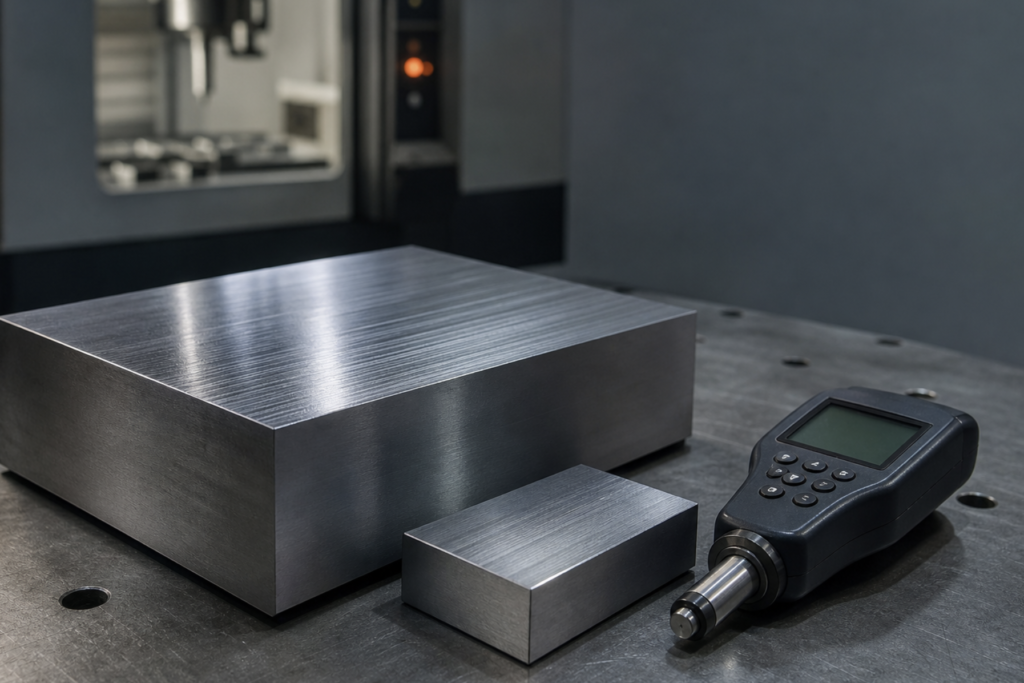
This is a process question, not a materials question, and it is why the verification step matters more than the grade name. In our shop, hardness verification on tool steel blocks is part of the standard inspection record — you can read more about how that works on our quality control page.
Three questions to ask before you approve the steel spec
- What is the actual grade and hardness value? A range is fine. A name alone is not.
- What is the expected life in shots for this grade, with my resin, at my cycle? If the answer is a number, the shop has thought about it. If it is “many years,” they have not.
- How is the hardness verified, and do I get the record? The answer separates shops that control their heat treatment from shops that outsource it and hope.
The cost gap is smaller than the risk gap
Moving from a generic P20 block to a nickel-added pre-hardened grade, or from pre-hardened to properly heat-treated stainless, adds a modest amount to the tooling invoice. Steel is a fraction of total mold cost — machining, EDM, polishing, and the mold base carry the rest.
What it avoids is the expensive outcome: a cavity that washes out at 60,000 shots on a part you needed to run for 500,000, a re-cut you did not budget for, weeks of requalification, and a production line waiting on a tool that was never specified in the first place.
Specifying steel properly costs less than discovering it was never specified.
Frequently asked questions
Is 718H better than P20?
For most production tooling, yes — it holds hardness deeper into large blocks and takes a better polish. For a short-run bridge tool in a benign resin, a sound P20 block is a reasonable, economical choice.
Can I use one steel for the cavity and another for the core?
Yes, and it is often done. Cores take more wear and often run hotter, so a harder grade on the core with a pre-hardened cavity is a common combination on medium-volume tools.
Does glass-filled material always require H13?
No. It requires hardness and, in most cases, a wear-resistant surface treatment. On medium volumes, a properly heat-treated stainless grade with nitriding is a common and effective answer.
How do I know the steel in the mold is what the quote promised?
Ask for the hardness verification record and, where relevant, the steel mill certificate tied to the block. A supplier who cannot produce either is asking you to take the steel choice on faith.
Getting the steel decision right the first time
Send us your part data, your resin specification, and your expected annual volume. We will recommend a grade, state the hardness range, and quote it as a named line item rather than as “mold steel” — so the decision stays visible from the first quote through final inspection. You can start a quote request here.
Author: Jack Qiao works with the engineering team at Kysen Mold, a Shanghai-based injection mold manufacturer serving overseas OEMs.
Website: www.kysenmold.com