When a buyer in Stuttgart sends a STEP file at 4 PM their time, they’re already halfway through their workday. By the time their Chinese mold supplier starts a shift, it’s 10 PM in Shanghai. The traditional model says: “We’ll get back to you in 3 to 5 days with DFM feedback.”
That model is breaking.
Three days of silence in a cross-border sourcing relationship means three days of uncertainty. The buyer doesn’t know if the part is manufacturable, if the gate location works, or if the draft angle needs redesigning. They don’t even know if the supplier has opened the file.
For an injection mold manufacturer, a 24-hour DFM turnaround isn’t just a speed metric — it’s a trust mechanism that rewires how buyers and suppliers collaborate across time zones.
What exactly happens inside a 24-hour DFM cycle?
Most buyers only see the output: a marked-up drawing, a mold flow snapshot, and a list of recommended changes. The real engineering happens in the hours before that PDF lands in their inbox.
Gate 1: File ingestion and geometry audit (Hour 0-2)
The moment a STEP, IGES, or X_T file arrives, the first task isn’t design — it’s verification. The engineering team checks three things immediately:
1. File integrity. Does the model open cleanly without missing surfaces? A STEP file exported from SolidWorks 2021 — like a typical automotive clip component — often carries surface trimming data that doesn’t translate perfectly across CAD platforms. If the file has gaps, the team flags it within the first hour rather than discovering it three days later.
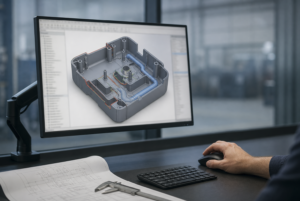
2. Parting line feasibility. The software extracts the parting surface automatically, but the engineer manually inspects for undercut zones, sharp internal corners, and slider requirements. This step answers the most expensive question in mold design: “Can this be made in a two-plate mold, or does it need slides and lifters?”
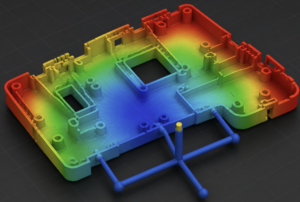
3. Wall thickness heatmap. Using mold flow simulation software, the team generates a thickness distribution map. A part that looks uniform to the human eye often has 30-40% thickness variation at rib intersections and boss locations. These become sink mark risks that the DFM report will flag.
Gate 2: Gate location and filling analysis (Hour 2-6)
This is where plastic injection molding simulation separates an experienced mold maker from a machine shop with a CNC.
The engineer runs a preliminary filling analysis with the customer’s specified material — typically a glass-filled nylon (PA66-GF30) or a PC/ABS blend. The simulation answers:
- Where does the melt front converge? (Weld line prediction)
- What’s the pressure drop from gate to last-filled region?
- Is there a risk of short shots at the specified wall thickness?
For a small cord guide clip — roughly 25mm wide and 35mm long — the difference between a single edge gate and a submarine gate can mean a 15% cycle time variation. The DFM captures this within hours, not days.
The practical output of Gate 2: A screenshot of the filling pattern, a gate location recommendation (often with 2-3 alternatives ranked by quality/cost), and a pressure distribution plot.
Gate 3: Cooling and warpage prediction (Hour 6-12)
Cooling design is where mold cost and part quality collide. A simpler cooling layout means a cheaper mold. A conformal cooling layout means faster cycles and less warpage — but higher tooling cost.
At the 12-hour mark, the DFM report includes:
- A cooling channel layout proposal (baffles, bubblers, or straight-through)
- Predicted cooling time per cycle
- Warpage simulation results — showing deflection in X, Y, and Z axes
This is the gate that most differentiates a 24-hour DFM from a 72-hour DFM. Running a complete Cool + Fill + Pack + Warp analysis on a multi-cavity mold typically takes 4-6 hours of computation time alone. A shop that can deliver this within 12 working hours has either invested in simulation hardware, optimized their analysis templates, or both.
Gate 4: Report compilation and customer-ready output (Hour 12-24)
The final 12 hours aren’t about running more simulations. They’re about translating engineering findings into a buyer-facing document:
| Buyer’s unspoken question | What the DFM report should answer |
|---|---|
| “Can you actually make this?” | Parting line feasibility, slider count, mold base size |
| “Will my part look good?” | Gate vestige location, weld line visibility, surface finish |
| “How fast can you run it?” | Predicted cycle time, cooling time breakdown |
| “What should I change?” | Draft angle recommendations, wall thickness adjustments |
| “How much will the mold cost?” | Cavity count options, steel grade recommendations, price drivers |
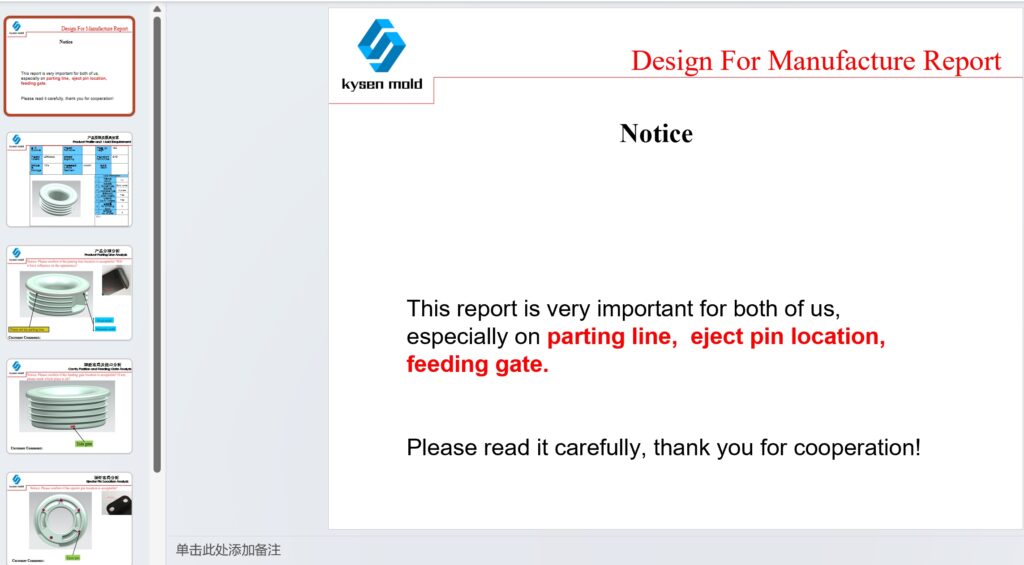
A strong DFM report includes:
- A one-page executive summary (for the procurement manager)
- Marked-up CAD screenshots with callouts (for the design engineer)
- Filling/cooling/warpage simulation results (for the technical reviewer)
- A prioritized list of design change recommendations with estimated cost impact (for the project manager)
Why this matters for cross-border mold sourcing
The traditional 3-5 day DFM cycle creates a dangerous information vacuum:
- The buyer starts conversations with 2-3 other suppliers “just to compare”
- The buyer’s internal design team continues modifying the part — but without manufacturing input
- The buyer’s confidence in the supplier erodes silently
A mold tooling supplier with a 24-hour DFM capability doesn’t just deliver answers faster. It prevents the buyer from drifting.
Once a buyer receives a comprehensive DFM within one business day, they invest psychologically in that supplier’s feedback. They forward the report internally. They schedule a call to discuss the recommendations. The conversation shifts from “can you quote this?” to “let’s optimize this together.”
One practical example
A European buyer recently submitted a STEP file for a small automotive cable guide clip — approximately 25mm x 35mm x 9mm, designed in SolidWorks 2021 and exported as STEP AP214. The part had U-shaped geometry with inward-facing snap hooks, cylindrical bosses, and multiple B-spline surfaces.
Within 24 hours, the DFM report identified:
Draft angle deficiency: The snap hooks had 0.5° draft. The report recommended 1.5° minimum for reliable ejection, with a detailed explanation of why the original angle risked scuffing.
Gate location trade-off: The report presented three gate options — edge gate (lowest cost, visible vestige), submarine gate (hidden, moderate cost), and valve gate (best quality, highest cost) — with cycle time and cost impact for each.
Cooling optimization: The cylindrical boss regions showed 12°C higher temperature than the main body in simulation. The report proposed a bubbler insert to balance cooling, reducing predicted cycle time by 18%.
Material recommendation: The buyer specified unfilled PA66. The DFM flagged that the thin wall sections (1.2mm) might cause short shots and recommended PA66-GF15 as an alternative with filling analysis comparison.
The buyer’s response: “This is the most detailed DFM we’ve received from an overseas supplier. We’re adjusting the snap hook draft angle per your recommendation.”
That’s what a 24-hour DFM does. It turns a quote request into a collaboration.
Need a DFM review of your part design? Contact Kysen Mold — we deliver DFM feedback within 24 hours, no obligation.