Sourcing injection molds from China isn’t complicated. What’s complicated is separating the 1,200 sqm factory with in-house EDM and CMM from the trading company that subcontracts to five different workshops.
The difference between the two? About 40% in mold cost, three weeks in lead time, and a level of quality control that either wins or loses you the project.
Here are seven questions European buyers should ask before sending an RFQ to a
Here are seven questions European buyers should ask before sending an RFQ to a China injection mold manufacturer — and what the answers actually tell you.
1. What steel grades do you stock, and can I specify the brand?
This single question eliminates about 60% of suppliers immediately.
A proper injection mold factory stocks at least three grades of mold steel on-site: P20 (pre-hardened) for low-volume production molds, 718H or equivalent for medium-to-high volume, and H13 or S136 for high-wear or high-polish applications.
But stocking the steel isn’t enough. The real question is whether you can name the brand. A supplier who says “we use German steel” is vague. A supplier who says “we stock ASSAB 718HH, Finkl P20, and Buderus 1.2344” knows exactly what’s on their rack.
Why this matters: If you’re producing a transparent polycarbonate medical component, you need S136 with a mirror polish. If the supplier substitutes a generic equivalent because “it’s similar,” you’ll discover the difference when your part comes out with flow marks after 50,000 shots.
2. What does your DFM report include, and what is your turnaround time?
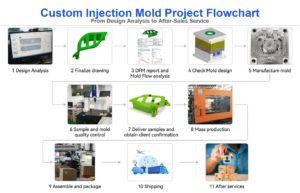
Not all DFM reports are created equal. Some are a single page with a parting line suggestion. Others are a 12-page document covering gate location alternatives, filling analysis, cooling channel layout, predicted warpage, and a prioritized list of design change recommendations with cost impact.
Ask for a sample DFM report from a previous project. If the supplier won’t share one or says “we’ll prepare it after you place the order,” you’re not talking to a
Ask for a sample DFM report from a previous project. If the supplier won’t share one or says “we’ll prepare it after you place the order,” you’re not talking to a custom injection molding partner — you’re talking to a machine shop that will build exactly what your drawing says, problems and all.
The best suppliers deliver a preliminary DFM within 24 hours. Not because they’re cutting corners, but because they’ve invested in mold flow simulation software and standardized report templates. If a supplier needs five days for a DFM, it usually means they’re outsourcing the analysis — or not doing one at all.
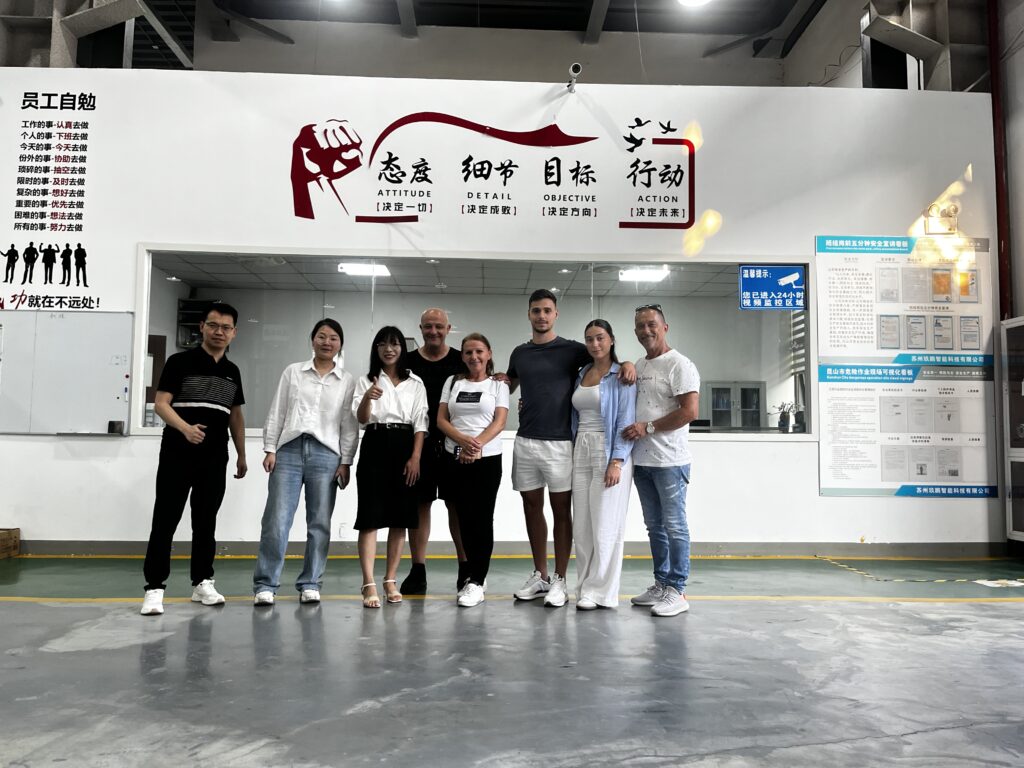
3. Can I visit your shop floor, or at minimum see a live video walkthrough?
This is about more than just verifying the factory exists. A walkthrough tells you:
- Are molds being built, or is the shop floor empty?
- What brands of CNC machines are on the floor? Makino, DMG MORI, and GF Machining Solutions are industry standards.
- Is there a dedicated CMM room, or is quality inspection done with hand tools in a corner?
- How many active mold builds are in progress? A healthy shop has 10-20 molds in various stages.
If an on-site visit isn’t possible, a live video call where you can direct the camera — not a pre-recorded tour — achieves the same goal. Suppliers who decline this usually have something to hide.
4. What is your mold life warranty, and what does it actually cover?
Mold warranties fall into three tiers:
- No warranty: “The mold works when it leaves our floor.” Avoid these suppliers.
- Basic warranty: “We guarantee 100,000 shots under normal operating conditions.” This is standard but vague. What are “normal” conditions?
- Detailed warranty: “We guarantee 500,000 shots with PA66-GF30 at 280°C barrel temperature, 80°C mold temperature. Warranty covers cavity surface wear exceeding 0.05mm, ejector pin failure, and hot runner system malfunction.”
The detailed warranty tells you the supplier has actually measured their mold life rather than guessing. It also signals they know your material and process intimately enough to commit to a specific number.
5. How do you handle mold trials and what machine will my mold run on?
A mold trial at the supplier’s facility serves two purposes: proving the mold works, and establishing a process baseline for future production. The key detail is the injection molding machine the trial runs on.
Ideally, your mold runs on a machine with similar specifications — clamp force, injection rate, screw L/D ratio — to your production machine. If an
Ideally, your mold runs on a machine with similar specifications — clamp force, injection rate, screw L/D ratio — to your production machine. If an automotive injection mold designed for a 300-ton press is trialed on a 150-ton machine, the results are meaningless.
Also ask: who runs the trial? A dedicated process engineer who documents every parameter, or the operator who happened to be free that afternoon? The trial report should include cycle time, injection pressure profile, cooling time, and shot weight variation across 50 consecutive shots.
6. What happens if the mold needs modification after delivery?
Every mold eventually needs adjustment. A cavity insert wears. A design change requires a new gate location. A product revision demands a different texture.
The question isn’t whether the mold will need service — it’s what the process looks like when it does.
- Do you have a local partner who can handle minor repairs, or does the mold have to ship back to China?
- What’s the typical turnaround time for a cavity insert replacement?
- Are CAD files, electrode drawings, and spare parts included in the mold delivery package?
The answer to #3 is critical. A mold delivered without electrodes means every future repair requires reverse-engineering the original geometry. A mold delivered with a complete spare parts kit and organized documentation means your local toolroom can handle 80% of future issues.
7. Can you provide three references from European customers in my industry?
This is the closing question. A supplier who provides three references — with contact details you can actually verify — is worth shortlisting. One who says “our customers prefer confidentiality” is probably not hiding customer secrets. They might just not have long-term European customers.
When you call the references, ask three things:
- Did the mold arrive on time?
- How many rounds of modification did it take to get production-quality parts?
- “Would you use them again?”
The third question is the only one that matters. If the reference hesitates, that’s your answer.
The bottom line
A good China injection mold manufacturer isn’t the one with the lowest quote. It’s the one who can answer all seven of these questions without deflecting, can back up every claim with documentation, and treats your first mold as the start of a five-year relationship, not a one-off transaction.
Next time you’re about to hit “send” on an RFQ, run through this list first. The molds you don’t buy are sometimes more important than the ones you do.
Next time you’re about to hit “send” on an RFQ, run through this list first. The molds you don’t buy are more expensive than the ones you do.
————————————————————————————————————————
Author: Jack Qiao is an engineering project manager at Kysen Mold, a Shanghai-based injection mold manufacturer specializing in automotive, electronic, and consumer product tooling. The company operates a 1,120 sqm facility with ISO 9001 certification and provides DFM feedback and quotations within 24 hours.
Website: www.kysenmold.com